Research Portfolio
Working papers and projects.
Dynamic Multihoming by Content Providers in Platform-based Markets: Focus on the US Videogaming Industry
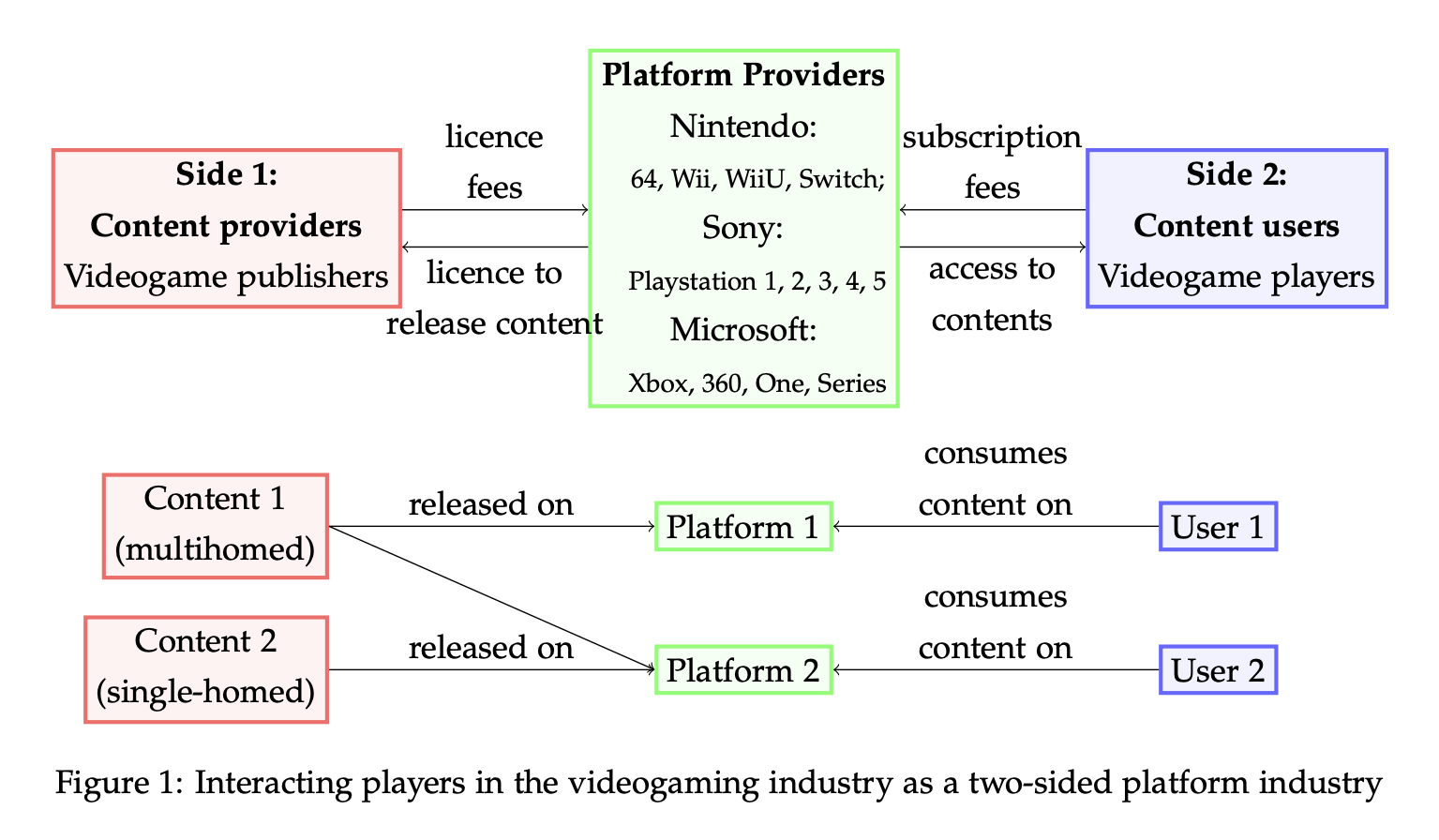
This study is an empirical analysis of the effect of a new platform provider entry on multihoming decisions by content providers in two-sided platform industries. I focus on the home console video game industry in the US and assess the role played by Microsoft’s entry as a console manufacturer on the pattern of exclusive releases. In the home video game industry, game developers and publishers (content providers) develop game titles for consoles (platforms) and compete for the existing consumers who own those consoles. The possibility for content providers to publish their content on multiple platforms (multihoming), and eventually with timed exclusivity, is an interesting feature of two-sided platform industries. Online-gathered data show a big jump in the multihoming ratio among quarterly releases of video games on home consoles in the US, after Microsoft’s entry as a console manufacturer in 2001. There are two key mechanisms influencing the extent of multihoming: (1) the size of the consumer group on each platform (installed base), and (2) the platform-specific development costs. Focusing the analysis on releases that occurred during the 1995-2016 period, I estimate a single-agent dynamic discrete choice model of platform targeting by content providers. I find that the installed base significantly impacts payoff, but requires a very large variation to shift the distribution of releases across platforms. As for the estimated costs, they are found to have the same pattern described by industry sources: platform-invariant development cost estimates increase over time, platform-specific porting cost estimates and their disparities decrease across generations. These trends mean that the cost of multihoming is declining over time. In addition, counterfactual simulations show that Microsoft’s entry as a console provider has played a role in sustaining a long-term increase in multihoming, as it is estimated to have increased the ratio of multihomed video game releases by 10 to 13 percentage points.
Demand analysis with interval-valued sales
Most empirical demand studies assume that product sales and market shares are fully observed, so that mean utilities are point-identified. This assumption is restrictive in digital markets, where downloads or installs are often reported in intervals, such as Google Play Store. Interval-valued sales can also arise when only aggregate market sales are observed. This paper studies discrete-choice demand estimation when sales are interval-valued. In a conditional logit model, interval-valued sales imply bounds on mean utilities and lead to moment inequalities and partial identification of demand parameters. I implement and compare two existing inference approaches: a max-statistic test for moment inequalities and a support-function approach that delivers projected identified intervals for individual coefficients, with smoothing for discrete instruments. Simulations show that replacing each interval by its midpoint can lead to biased and overly precise estimates. I then provide two empirical illustrations. In the Steam application, using data on recent casual action-adventure video games, the partial-identification confidence region allows economically consistent negative values of the price coefficient, while midpoint-based confidence intervals rule them out. In the Google Play Store application, using free puzzle apps released in 2019, midpoint-based estimation suggests several significant effects. The partial-identification results are more cautious: only the intercept and the log rating-count-per-day coefficient rule out zero, and the empirical identified set reveals trade-offs across parameters that a single midpoint estimate cannot show.
Estimating marginal costs from discrete prices and product characteristics: An application to mobile plans
We propose a new approach to identify marginal costs of differentiated products when prices and other observed product characteristics are discrete. It boils down to a discrete choice problem allowing for flexible distributions of unobservables, therefore avoiding strong distributional assumptions on unobserved demand shocks. Our approach treats the conditional expectation of demand as a nuisance function. If data about market shares or sales are available, one can estimate this nuisance function prior to recovering marginal costs. If demand data are not available, we leverage a natural exclusion restriction between costs and demand, and approxi- mate the nuisance function using differences of observed product characteristics. Our identification procedure features appealing computational properties despite the large number of parameters. Simulation evidence suggests that the ability to precisely recover marginal costs depends on the quality of the approximation of the demand’s conditional expectation.
Public Actors’ Expenditures and Pollution in the Waste Management Sector
This paper examines the extent to which the activity of public and private waste management actors influences waste diversion intensity and non-CO2 greenhouse-gas (GHG) emissions from biomass in Canada. We estimate (i) a Cobb–Douglas production function to predict the value of public-sector output; (ii) event-study models explaining total GHG emissions from biomass; and (iii) a pollution model explaining the intensity of waste diversion and the resulting GHG emissions. The analysis uses a provincial panel covering 2002–2018. The key variables capture capital expenditures, operating expenditures, and operating revenues of municipalities and firms, as well as flows and stocks of landfilled waste. Results from the event-study models (ii) show that municipal capital expenditures in waste management are associated with a significant reduction in GHG emissions at a +3-year horizon (a delayed effect), whereas firms’ capital is not significant. Firms’ economic activity (revenues) is linked to a reduction in GHG emissions in the following year according to the event-study estimates; however, the pollution model (iii) indicates that a 1% increase in firms’ output raises waste diversion intensity by 0.22%, while a 1% increase in predicted municipal output reduces it by 0.151%. GHG emissions respond strongly to new waste inflows and, more modestly, to accumulated stocks, confirming the importance of addressing both inflows and stocks simultaneously. Provincial heterogeneity suggests differentiated policies. Overall, the findings argue for greater public investment (composting, recycling, landfill-gas capture) in waste management.
🧩🔧 “All models are wrong, but some are useful.” 🧩🔧 — George E. P. Box